


Wow. The latest industry data is pretty clear. If you look at new electric boats being built today, most are powered by lithium-iron phosphate batteries. This isn’t a small trend. It’s become the standard choice. The growth in this market has been significant. As someone with 15 years in the lithium battery industry, I’ve seen this shift happen. We’ve worked closely with several electric boat builders. I’ve put together technical details and real case data. Today, I want to look at why this technology is taking over. My goal is to show you how it can give your products a real advantage.
Exceptional Safety. The Core Advantage.
Now, I will show you the strong safety of LFP batteries in three ways. We will see the results together.
Performance Comparison
First, let’s look at a simple table. It shows a side-by-side comparison of the safety performance of three common battery types. I’ll break down what these differences mean for you.
Safety features | Lithium iron phosphate battery (LiFePO₄) | Ternary lithium battery (NCM/NCA) | Lead-acid battery |
Thermal runaway starting temperature | About 500C | About 200°C | Hydrogen explosion (failure modes vary) |
Needlestick testing | Usually does not ignite, does not explode | Temperatures soared, and even fires and explosions occurred | Internal short circuit (failure mode varies) |
Overcharge and overdischarge tolerance | preferably | Poor, the cathode structure is easy to collapse, and the risk is high | Poor, fragile |
Long-term reliability | Long cycle life, slow attenuation | The cycle life is relatively short, and the attenuation is fast | The service life is short and requires regular maintenance |
Actual Accidents
Next, let’s turn to a comparison chart of recent safety incidents.

The data reveals that NMC (Nickel Manganese Cobalt) batteries account for the majority (69%) of fire incidents in new energy vehicles, while LFP (Lithium Iron Phosphate) batteries are involved in 21% of cases. The remaining 10% of incidents involve batteries of an undetermined type.
Unique Structure
So why does LFP battery technology perform so well? It all comes down to its unique olivine crystal structure. Let me show you what that means.

So, picture the inside of an LFP (LiFePO₄) battery like a super-strong “brick wall.” This is its olivine structure—the foundation of its absolute safety. Even under high heat, this wall won’t collapse or burn.
But there’s a catch. The bricks themselves don’t conduct electricity well. And the wall only has narrow “one-lane roads” (one-dimensional channels) for lithium ions to move through. This originally made charging slow and caused heat buildup.
Solution
The smart solutions were simple:
- Coat the bricks in graphite (carbon coating): This lets electrons flow quickly along the surface, slashing electrical resistance and heat.
- Break big bricks into tiny grains (nanoscale particles): This dramatically shortens the distance ions have to travel, making charging faster and more even.
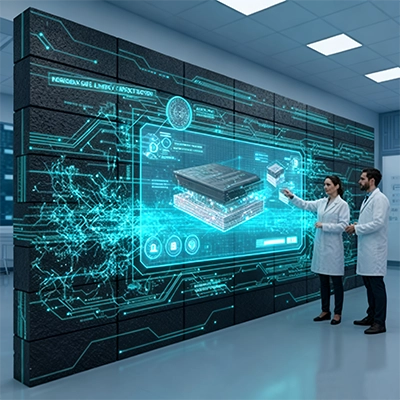
The result? We kept the wall’s original strong structure but added an efficient “electron highway” and “ion shortcut.” This gives us a battery that is both incredibly safe and highly capable.
Excellent Performance in Tough Conditions.
Eco-Friendly by Design
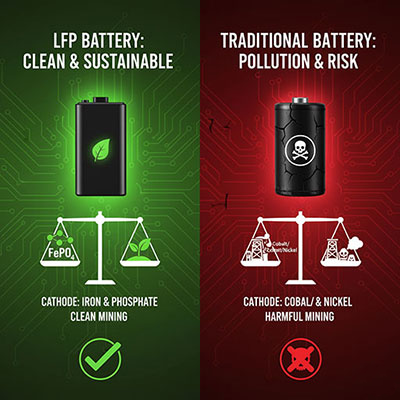
The cathode material—that’s the positive part of the battery—contains no heavy metals like cobalt or nickel. These materials are known to harm the environment.
Instead, it uses iron and phosphate. Iron is one of the most abundant elements in the Earth’s crust. Mining and processing it create far less pollution compared to cobalt or nickel.
Cobalt mining, for example, often produces highly acidic wastewater and radioactive byproducts. I’ve seen reports showing how damaging this can be.
We also planned for the unexpected. Even if the casing gets damaged, the LiFePO₄ material reacts safely with seawater.
It only forms inert, non-toxic iron phosphate. This is a stable, solid that simply settles. There’s no risk of it dissolving or being absorbed by marine life.
This is a key difference. Cobalt or nickel batteries could leak heavy metals into the water. These toxins can build up in the food chain. LFP batteries avoid this problem completely.
Built for The Ocean's Harsh Conditions
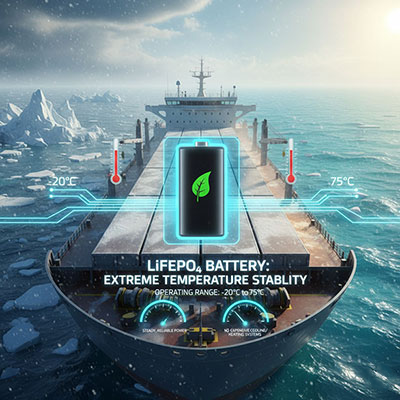
Ships at sea experience drastic temperature changes—from seasonal shifts to varying ocean climates. Temperatures can range from -20°C in freezing northern waters to 75°C on a sun-scorched tropical deck.
Thanks to its stable chemical structure, LiFePO₄ batteries offer an extremely wide operating temperature range. They deliver steady, reliable power in these extreme conditions—without needing expensive additional systems.
Ship Vibration Environment and Testing Standards
Vibration is a constant reality for ships. Batteries face non-stop shaking from engines, propellers, and waves—every day, all day.Over time, this can cause real problems. I’ve seen reports where vibration leads to:
- Internal parts are coming loose
- Cracks are forming in the battery case
- Worn-out connections at the terminals
- Even small short-circuits inside the cell
That’s why we test batteries against tough vibration standards. You need power you can count on, even when the sea gets rough. So when you’re choosing an LFP battery for marine use, make sure it has passed strict vibration tests. Look for standards like YD/T 2344.1-2011 or even tougher ones from classification societies. Always ask the supplier for third-party test reports. Don’t just take their word for it—see the proof.
Good testing means a battery that lasts, even in rough seas.
Economic Benefits of Marine LiFePO4 Batteries
Exceptionally Long Service Life
LFP batteries last significantly longer than traditional lead-acid batteries. Under 80% depth of discharge (DOD)—meaning using 80% of the battery’s capacity before recharging—they can deliver between 3,000 and 6,000 cycles while still retaining 80% of their original capacity. Some high-quality cells even exceed 8,000 cycles.
If you use and recharge the battery once per day, that translates to 8 to 16 years of reliable service.
Now, compare that to lead-acid batteries. They typically only last 500 to 800 cycles at just 50% DOD. Used daily, they might need replacement in 1 to 2 years.
Let’s look at the costs. A 100Ah LFP battery system might have an upfront cost of around $1,200 . A similar lead-acid battery costs much less initially, about $400.
The math is clear. You pay less over time with LFP. It’s not just a purchase—it’s an investment that pays for itself.

Maintenance Cost Analysis
One of the biggest advantages of LFP batteries is how little maintenance they need. This is a major part of their long-term value.
They’re completely sealed. You never have to:
- Check electrolyte levels
- Add distilled water
- Perform equalization charging
These are all routine—and messy—tasks with lead-acid batteries.
Based on industry estimates, this alone saves you around $120 per year for each battery system. That’s money and time back in your hands.
Understanding Policy Subsidies: New Energy Vessel Subsidy Policies Worldwide
Major shipping regions globally have introduced policies to support decarbonizing the shipping industry. Many of these measures directly or indirectly reduce the cost for ship owners adopting lithium iron phosphate (LFP) battery systems.
| Region | Policy/Program Name | Support Method & Amount/Ratio | Key Focus Areas |
| United States | Title XI Federal Ship Financing Program | Loan guarantees, priority approval. As of March 2022, approximately $35.5 million in subsidies were available, expected to support about $475 million in new loan guarantees. | Offshore wind vessels (designated as vessels of national interest), U.S. shipowners, and the construction of new ships or modernization in U.S. shipyards. |
| Europe (Example: Estonia) | Estonian Ship Green Conversion Scheme | Financial subsidies, up to 15%-30% of project costs, up to 30% for zero-emission projects. Total fund €25 million, maximum €5 million per project. | Hybrid propulsion systems, equipment using renewable fuels, exhaust gas cleaning systems, carbon capture systems, and energy efficiency digital solutions. |
| Australia | Hydrogen Headstart Program | Production credit incentive. The Western Australian Murchison green hydrogen project received A$814 million. Support for the hydrogen industry over the next decade is projected to be A$8 billion. | Production of green hydrogen and its derivatives (e.g., green ammonia), which can be used as marine fuel. |
| South Africa | Renewable Energy Masterplan | Tax incentives, industrial subsidies, etc. (to encourage local manufacturing). The goal is to attract at least ZAR 15 billion (approx. $784 million USD) in investment. | Develop local renewable energy manufacturing产业链, create green jobs. Support for SMEs and specific demographic groups. |
Conclusion
Marine lithium iron phosphate (LFP) batteries are a key power choice for modern vessels. They provide safety, durability, and cost efficiency. When you choose a battery, focus on thermal stability, cycle life, and environmental adaptability. These points ensure strong performance in marine conditions. We hope this overview gives you practical guidance for selecting the right marine battery. If you need more, our team specializes in marine LFP power systems. We bring over 15 years of experience.
With this background, we offer tailored solutions for shipbuilders and integrators. Our battery packages are reliable, certified, and cost-effective. Contact us for a free consultation. Together, we can power your projects with confidence.